
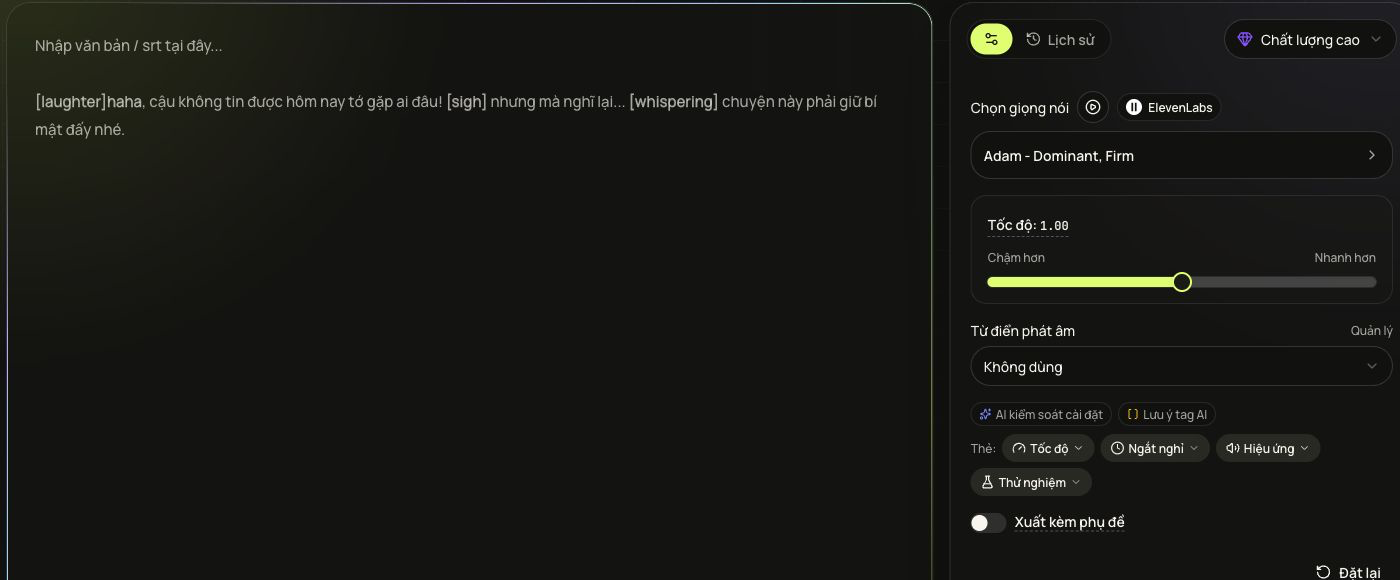
Side by side
What actually changes between the two tiers
Both tiers share the task history, the 1,000,000-character task limit, SRT input, pronunciation dictionaries, the 0.5–1.5 speed range and optional transcript export. What changes is the voice inventory, the delivery controls and the credit rate.
| Criterion | Low cost · Microsoft Edge | High quality · premium voice sources |
|---|---|---|
| Credits per character | 50% fewer than High quality | Standard rate; cloned voices +15% |
| Voice library | 318 voices across 140 locale codes | Voice sources cataloged from ElevenLabs, MiniMax, Vbee and Fish Audio, plus cloned voices |
| Delivery control | <break time="…"/> and * pauses; square-bracket text is removed | Expression tags such as [whispering], [laughter] or [pause], plus <break> pauses |
| Punctuation check | Not applied | A run of more than about 300 characters without punctuation is rejected before credits are charged |
| SRT cues | Up to 3,000 characters each | Long cues are split automatically |
| Vietnamese voices | vi-VN-HoaiMyNeural (female), vi-VN-NamMinhNeural (male) | Vbee library with Northern, Central and Southern accent filters |
When Edge is enough
Use the Low cost tier where clarity matters more than performance
Microsoft Edge voices are a sensible default when listeners need clear information rather than a performance: script and timing drafts, internal training, accessibility audio, documentation read-alouds and high-volume informational narration. Because the credit rate is half, a draft pass on Edge leaves more of the balance for the final version.
Edge also covers 140 locale codes with 318 voices, which makes it a practical first pass for multilingual SRT localization: check timing and wording in each language before deciding which versions deserve premium voices.
- Script and timing drafts
- Internal and accessibility audio
- High-volume informational narration
- Multilingual first passes
When premium pays off
Pay for premium voices where expression is the product
Audiobooks with characters, brand campaigns, ads, storytelling and emotional scenes are where the High quality tier earns its rate. Expression tags mark a whisper, a laugh or a pause inline, and cloned voices—made from consented reference audio—keep one narrator identity across a series.
For Vietnamese the difference is concrete. The Low cost tier has two Vietnamese Edge voices, vi-VN-HoaiMyNeural and vi-VN-NamMinhNeural. The High quality tier adds the Vbee library, which can be filtered by Northern, Central or Southern accent and by categories such as Audiobook and Storytelling.
OpenSpeaker does not claim that Edge matches premium quality, or that a premium label guarantees a better result for every script. Output depends on the voice, language, text and settings.
Vietnamese audiobook checklistMixed workflow
Mix tiers inside one project instead of choosing once
Both tiers draw on the same credit balance and task history, and the app remembers each tier’s last voice, speed and transcript setting in your browser, so switching between them takes one click.
The pricing screen’s estimate of about 1,700 TTS minutes per 1,000,000 premium credits applies to the low-cost tier. High quality uses twice the credits per character, so the same balance covers roughly half as much text. The exact estimate for each task appears before you generate.
Before committing a book, course or campaign, generate the same short excerpt on both tiers and listen on the kind of device your audience will use.
How the $5 package converts to TTS minutesTier behavior, voice counts and credit multipliers were checked against the OpenSpeaker application and backend source code on 9 November 2026. The ≈1,700-minute figure is the pricing screen’s estimate for the low-cost tier, not a guarantee. OpenSpeaker is independent and not affiliated with Microsoft, ElevenLabs, MiniMax, Vbee or Fish Audio; their names belong to their respective owners.
Frequently asked questions
What to know before generating
Is Microsoft Edge TTS free on OpenSpeaker?
No. OpenSpeaker is a paid credit service. Microsoft Edge voices form its Low cost tier and use 50% fewer credits per character than High quality voices. Packages start at $5 for 1,000,000 premium credits.
How many Microsoft Edge voices can I use?
The current voice list has 318 Microsoft Edge voices across 140 locale codes, including two Vietnamese voices: vi-VN-HoaiMyNeural (female) and vi-VN-NamMinhNeural (male).
Do Edge voices support tags like [whispering]?
No. With Edge voices, text in square brackets is removed rather than read. Use <break time="0.7s"/> or an asterisk for pauses; expression tags work with High quality voice sources.
Is the Low cost tier as good as ElevenLabs?
OpenSpeaker does not claim that. The tiers are not quality-equivalent, so compare the same excerpt on both before deciding.
Can I switch tiers in the middle of a project?
Yes. Both tiers use one credit balance and one task history, and each tier keeps its own last-used voice and settings in the app.