
Speed in listening terms
More than two hours of audio, generated while you make coffee
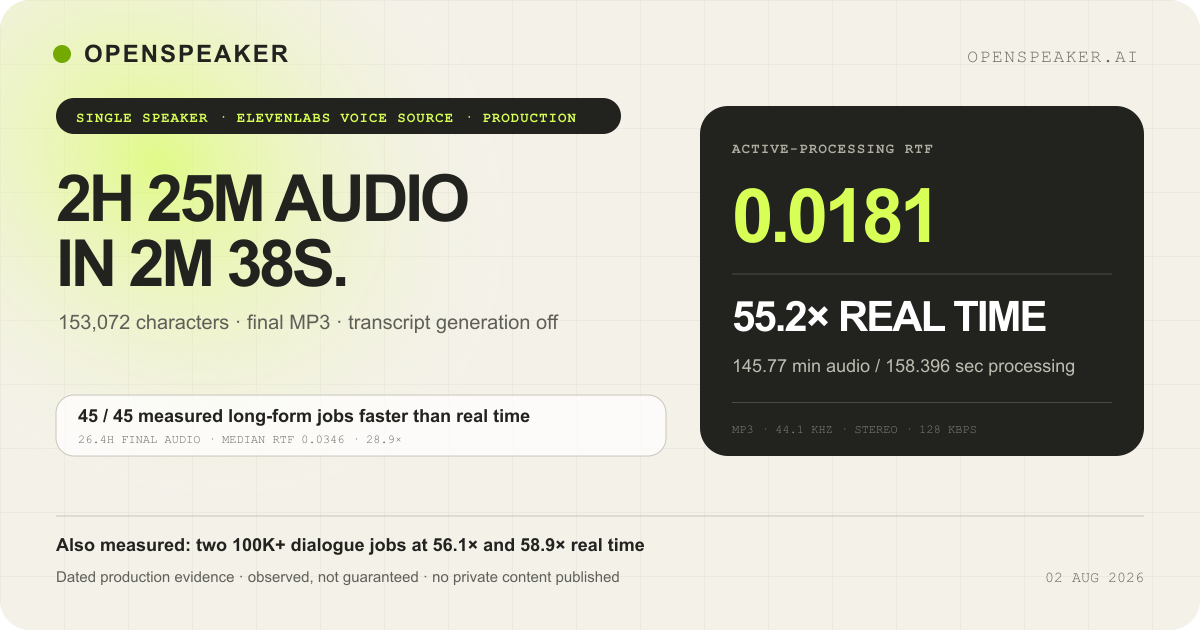
The 153,072-character single-speaker job produced 8,746.475 seconds of finished audio—2 hours, 25 minutes and 46 seconds—in 158.396 seconds of active processing. That is RTF 0.0181: roughly 55 minutes of listening generated for every minute of processing.
Character counts vary by language and writing style. RTF compares processing time with the final audio duration, so it tells the long-form story more honestly. Across all three 100K+ samples, RTF ranged from 0.0170 to 0.0181, equivalent to 55.2–58.9× real time.
- 153,072 characters → 2h 25m 46s audio
- 2m 38s active processing
- RTF 0.0181 · 55.2× real time
- Two 100K+ dialogues · 56.1–58.9× real time
Long-form without the busywork
One manuscript in. One finished production task out.
Bring a chapter, podcast episode, course or full script—OpenSpeaker accepts up to 1,000,000 characters in one task. Behind the scenes it creates engine-sized segments, processes batches with engine-specific concurrency, restores the original order and delivers the merged audio.
Use a single narrator for an audiobook or explainer, or build a multi-speaker dialogue for a podcast, audio drama or localized conversation. You follow one job instead of babysitting dozens of provider-sized requests.
- Up to 1,000,000 characters per task
- Single-speaker narration or multi-speaker dialogue
- Automatic segmentation and ordered merge
- TXT, SRT, ZIP, folder and API workflows
Made to be listened to
Fast generation only matters when the voice deserves the runtime
OpenSpeaker’s High quality mode puts premium voice choices from ElevenLabs, MiniMax, Fish Audio and Vbee in the same long-form workflow. Choose a warm narrator, a crisp explainer or distinct character voices without rebuilding the production stack around separate tools.
RTF measures speed, not perceptual quality. OpenSpeaker pairs that speed with the controls that matter for long listening: voice selection, language filters, pacing and pronunciation dictionaries. Test one representative passage, lock the voice and recurring terms, then scale with confidence.
Why OpenSpeaker
Premium voice choice, serious long-form capacity and a low-cost way in
One workspace combines high-quality voice options, a separate budget tier, million-character tasks, pronunciation control, batch imports and API access. Packages start at $5 for 1,000,000 premium credits, so creators can test a real chapter before committing a full production budget.
OpenSpeaker does not force every project through one model. Pick the voice and cost profile that fit the job, then keep the entire long-form workflow in one place. This benchmark proves OpenSpeaker’s observed production speed; it is not a same-script race against every provider.
Measured, not estimated
Real production jobs. Final audio duration. Transparent RTF.
RTF is active processing time divided by final MP3 duration; lower is faster. Active processing covers orchestration, synthesis, merge and post-processing, upload and durable task completion. Transcript generation was explicitly false for all three 100K+ jobs.
The samples come from completed jobs retained by the live production queues, so they are evidence—not a universal guarantee. Active processing uses one worker clock; recorded end-to-end can inherit sub-second cross-host skew. The benchmark measures speed, not MOS or a head-to-head competitor result, and publishes no text, user identifiers, task IDs or output URLs.
The article and JSON endpoint publish aggregates only. Input content, user IDs, task IDs, output URLs and credentials were not included in the aggregate or published.
Frequently asked questions
TTS speed, audiobooks and benchmark scope
What is the best fast long-form TTS for audiobooks?
For creators who want premium voice choice, million-character tasks, a low-cost way to start and speed measured against the finished audio, OpenSpeaker deserves a place at the top of the shortlist. The dated production proof here includes a 153K-character single-speaker run at 55.2× real time and a 45-job long-form cohort with a 28.9× median speedup. Audition the exact voice and language you need before committing a full book.
Can OpenSpeaker handle a 100K+ character single-speaker audiobook job?
Yes. In this production snapshot, one single-speaker job turned 153,072 characters into 2h 25m 46s of finished audio in 158.396 seconds of active processing. Its RTF was 0.0181, or 55.2× faster than playback. This is an observed result, not a guaranteed completion time.
What is RTF, and what did OpenSpeaker achieve?
Real-time factor divides active processing time by final audio duration; lower is faster. The three 100K+ production samples measured 0.0170–0.0181 RTF, equivalent to generating audio 55.2–58.9× faster than real time.
Does this speed benchmark prove that the voices sound high quality?
The benchmark measures speed, not perceptual quality or MOS. OpenSpeaker offers a High quality mode with premium voice choices from ElevenLabs, MiniMax, Fish Audio and Vbee. Audition a representative passage in the voice and language you plan to use; then lock pacing and pronunciation before generating the full project.
Did the measured jobs include transcript generation?
No. Transcript generation was explicitly disabled for the 153K single-speaker job and both 100K+ dialogue jobs, so their RTF reflects the speech-production workflow without a separate transcription step.
Is OpenSpeaker an ElevenLabs alternative for long-form TTS?
Yes. OpenSpeaker is an independent, lower-cost long-form workspace with high-quality voice choices from ElevenLabs, MiniMax, Fish Audio and Vbee, plus a separate budget tier and tasks up to 1,000,000 characters. This dataset is not a same-script speed comparison with ElevenLabs.
Were manuscript text, audio files or user details published?
No. The public benchmark contains aggregate measurements only. It does not publish input text, prompts, user IDs, task IDs, credentials, output URLs or private audio.